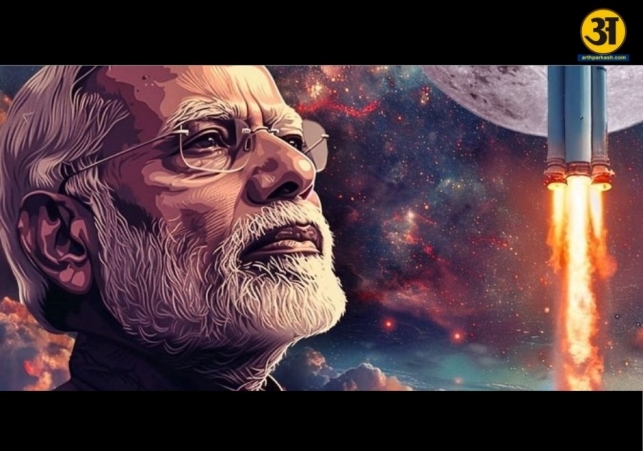
Modi’s vision drives India’s space renaissance
PM Modi’s vision sparks a new era in India’s space journey
India’s space journey has entered a new era, thanks to the visionary leadership of Prime Minister Narendra Modi. From celebrating the success of Chandrayaan-3 to accelerating the Gaganyaan human spaceflight mission, Modi has made space exploration a key part of India’s global stature. The soft landing of Chandrayaan-3 near the lunar south pole in 2023, at the “Shiva Shakti Point,” put India in an elite group of nations and showcased India’s scientific and technological strength. This milestone is celebrated each year on National Space Day, reflecting the government’s commitment to combining innovation with national pride.
Under PM Modi, India has redefined its space policy to include and empower private startups. The creation of the Indian National Space Promotion and Authorisation Centre (IN-SPACe) in 2020 opened the sector to private companies, making ISRO not just an operator but an enabler of the broader ecosystem. Today, over 300 space startups operate in India, attracting more than $500 million in investment over the past five years. These reforms have allowed private companies to build satellites, rockets, and other space technologies, accelerating India’s rise as a space power.
The Modi government has focused not only on technology but also on practical applications of space research. ISRO’s work now supports governance, agriculture, disaster management, urban planning, and telecommunications. By combining scientific achievement with national development, the space programme under Modi has become a tool for both innovation and practical benefits for citizens. This integration ensures that India’s space investments have wider economic and strategic impact.
Lunar triumphs and future ambitions
The Chandrayaan-3 mission’s success was not just a technological feat but a historic moment for India’s space ambitions. By landing near the lunar south pole, India became the first country to reach this scientifically valuable region, known for its ice deposits. These resources could support future human settlements and fuel interplanetary missions, making India’s achievement a foundation for further exploration. The Pragyan rover’s scientific experiments provided critical data on the Moon’s composition and structure, strengthening India’s research capabilities.
PM Modi’s decision to name the landing site “Shiva Shakti Point” reflects the integration of India’s cultural identity with its scientific achievements. It symbolises the country’s civilisational pride and reinforces the message that India’s space programme is as much about national pride as it is about science. This symbolic and strategic approach inspires millions of young Indians to see space exploration as a path to both innovation and national achievement.
Looking ahead, India is preparing even larger projects. ISRO is developing a 40-story rocket capable of lifting 75 tonnes to orbit, enabling the launch of larger satellites and supporting the construction of the Bharatiya Antariksh Station (BAS), India’s own space station planned for 2028. The BAS will provide a permanent Indian presence in low Earth orbit, supporting research in microgravity, pharmaceuticals, and advanced materials, while serving as a base for future lunar and Mars missions.
ALSO READ: Why the UN declaring a famine in Gaza holds critical global importance | Explained
The Gaganyaan programme, India’s first crewed space mission, will launch human astronauts into orbit by 2027, completing extensive testing and validation. The programme integrates with broader space objectives, including the BAS and lunar missions, creating a clear pathway for India’s human space exploration ambitions. These initiatives demonstrate India’s shift from being a participant in global space activities to a leader capable of independent missions.
India’s growing capabilities are also recognised internationally. By contributing to missions such as SpaceX’s Axiom-4 flight, ISRO has proven its technical expertise and reliability. This strengthens India’s position as a trusted partner in global space exploration, expanding opportunities for collaboration while showcasing indigenous skills.
In conclusion, PM Modi’s vision has transformed India’s space programme into a pillar of national pride, technological progress, and strategic growth. From Chandrayaan-3 to Gaganyaan and the Bharatiya Antariksh Station, India is not only achieving milestones but laying a foundation for sustained leadership in space. The combination of government support, private sector participation, and scientific excellence ensures that India’s journey into space is ambitious, practical, and inspiring. With these achievements, India is moving from aspiration to reality, establishing itself as a major space power and motivating future generations to dream bigger.
Related News